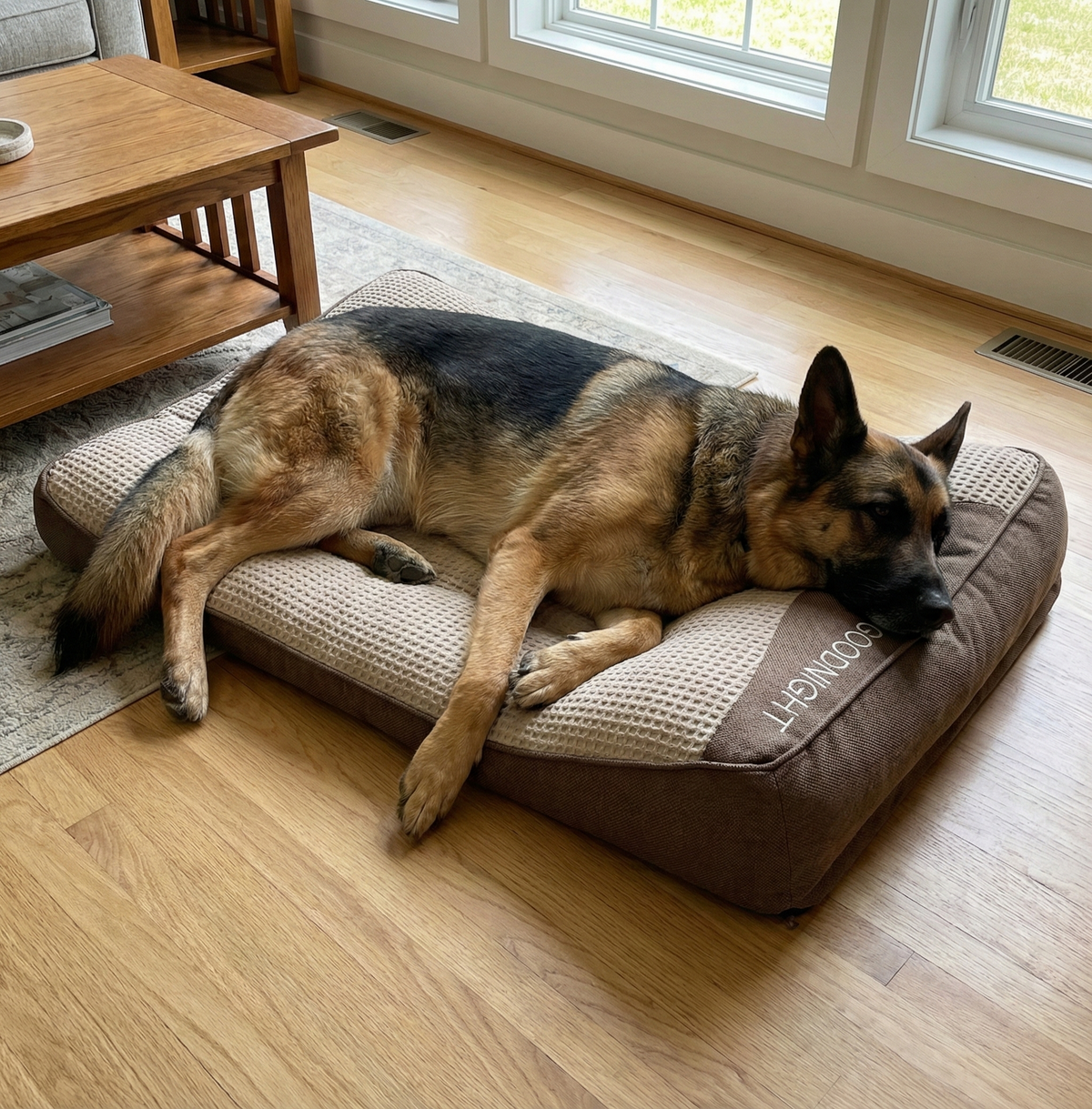
If your dog is over five — or a large breed of any age — you’ve probably noticed it. The slower stand. The pacing at 2am. The way they walk past their bed and lie on the hardwood instead. Most owners chalk it up to aging. It isn’t. It’s pressure. And the surface they’re sleeping on is making it worse, not better.
There’s a $400 million dog bed market in the U.S., and a quietly held truth inside it: the word ‘orthopedic’ isn’t regulated. Anyone can stamp it on a bed. Most do. What you’re actually buying, in nearly every case, is a fabric sleeve stuffed with polyfill or low-density foam — the cheapest possible filler, designed to feel soft in the box and look plush in the photos. It compresses within weeks. By month three, your dog is sleeping in a crater.
“She’ll lay down, and not even two minutes later she’s up. The cycle repeats. I’d stopped sleeping.”
The orthopedic lie
Linda from Portland told us her 11-year-old lab Bear used to pace until midnight. She’d lie down, get up, lie down again. The cycle would repeat for hours. She’d bought three orthopedic beds before she figured out what was happening: every bed she bought had collapsed in the middle within months, and Bear was effectively sleeping with her hips and elbows pressed against the floor through the failed foam.
“She’ll lay down, and not even two minutes later she’s up. The cycle repeats. I’d stopped sleeping.”
Why most beds fail the same way
We bought 12 of the most popular ‘orthopedic’ dog beds on Amazon and Chewy. We cut them open. Eleven of them had the same construction: a thin layer of memory foam on top, a thick layer of low-density polyfill underneath. That polyfill is the part that fails. It compresses permanently under 60–80 lb of weight within 8–12 weeks. After that, the memory foam on top has nothing supporting it — so it sinks too. Your dog ends up below the support line, not on it.
The problem is structural, not aesthetic. A bed can look pristine on the outside and be completely failed inside. By the time owners notice the crater, the dog has usually already given up on the bed. Which is why so many senior dogs end up back on the floor.
“He stopped sleeping on the tile. That’s all I needed.”
— David L., Phoenix, AZ“150 lb dog with bad hips. He can get up on his own again.”
— Sarah K., Brooklyn, NYWhat needs to actually be in the bed
A bed built to support an aging dog needs three structural elements most beds skip. First: a high-density closed-cell base layer (the support core) — this is the layer that doesn’t compress. Second: a contouring memory foam layer above it that distributes weight across hips, shoulders, and elbows instead of concentrating it. Third: a non-slip base, because if the bed slides every time the dog tries to push off, they stop trying.
The fourth thing nobody talks about: the washing system. Most beds have plastic zippers that fracture in the first hot wash. Once the zipper fails, the cover doesn’t come off again. The bed never gets washed. The smell sets in. The dog eventually refuses to use it. PawTherapy uses an industrial YKK metal zipper tested through 50+ wash cycles, plus a sealed waterproof inner liner that keeps the foam dry no matter what happens on top.
“She sighs when she lies down on it. That sigh tells you everything.”
What changes when you fix the surface
Most owners we surveyed reported the same pattern: the dog claims the new bed within 3 to 5 nights. The 2am pacing stops. They start sleeping through. The owner starts sleeping through. Some dogs took up to two weeks — usually the ones who’d been through several failed beds and had stopped trusting the category entirely. That’s normal. The bed isn’t doing magic. It’s doing what beds were always supposed to do.
Try it free for 30 nights. We’ll pick it up if it doesn’t work.
Free U.S. shipping. No restocking fee. The bed sits where your dog already sleeps — you don’t have to rearrange anything.
Try it free for 30 nights →