I spent $387 on dog beds before I figured out what was actually wrong.
For two years I thought Bear was just getting old. He was. But the surface he slept on was making it worse every single night — and it had a four-day fix I spent eight months walking past.

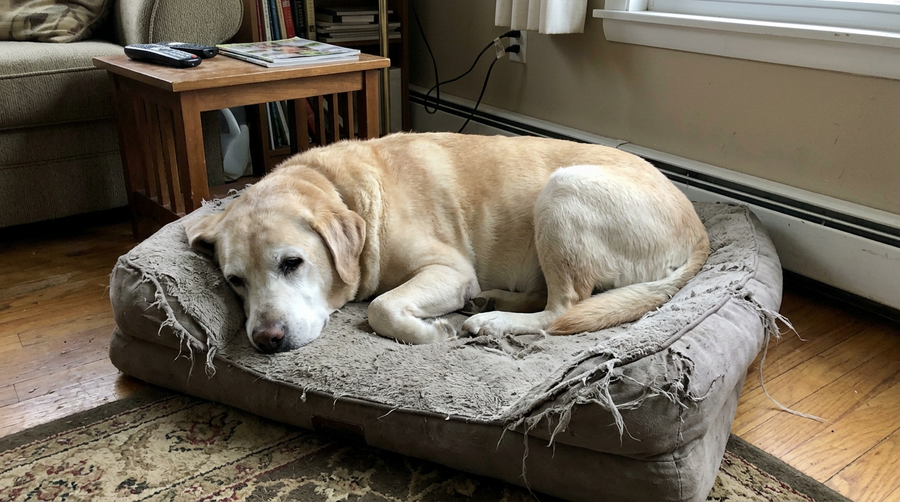
Bear, 11-year-old Lab, on the third bed I bought him. Six weeks in, the foam had already started to crater. (Photo: Laura Mitchell)
It started at 2:14 in the morning.
I know the exact time because I'd started checking my phone every time it happened — the way you do when something has been going on long enough that you've begun keeping evidence.
Bear would lay down. Not even two minutes later he'd push himself back up, circle, lay back down, get up again. I called it the cycle because I didn't have a better word for it. Eleven-year-old Labs aren't supposed to be spry, so I called it aging, and I went back to sleep. Or tried to.
Here's the part I have trouble writing even now: I was annoyed at him. At 2am, on the fourth get-up, I was lying there irritated at an old dog who was in pain — because nobody had told me he was in pain. The vet said arthritis is normal at his age. The internet said circling is normal. So I lay there losing sleep, feeling guilty about being angry, and not knowing how to help him. If you've been there, you know: it's its own special kind of awful. You love him. You feel helpless. Both at once, every night.
None of it was the wrong instinct. It was the wrong information. I was reading the label instead of the dog — and the label had been written to be read that way.
And if you've started doing what I did — noting the time, counting the get-ups, keeping evidence you're not even sure what to do with — understand what that actually means. You're paying attention. Most owners never get that far. They hear "he's just getting old" and they let it go. You didn't. Hold onto that, because it's the reason this fixed for us at all.
What I didn't know — what nobody told me, not the pet store, not the reviews, not my vet — was that the bed I'd bought him wasn't failing to help. It was actively making the cycle worse. Every night. On a surface that looked completely fine from across the room.

"He'd lay down, push himself back up, circle, lay down again. I called it the cycle. I called it aging. I was wrong about both."
The first three beds
Bed one cost $89. The product page used the word orthopedic in every photo caption. By week six, the middle had a hollow I could see from the doorway. Bear started sleeping on the hardwood next to it. I want you to sit with that image for a second, because I didn't: a dog choosing the floor over an $89 bed, and an owner deciding that was a personality quirk.
Bed two cost $134. Bigger, advertised as extra firm, removable cover. The zipper broke the first time I tried to wash it — four days in. The cover stayed on. The smell built. Bear stopped going near it within two months.
Bed three cost $164. Top of the recommendation list on a comparison site I trusted. By day 85, the foam had bottomed out enough that Bear's hips were resting on the floor through the bed. I missed the return window by five days, because I'd been telling myself it was getting better. That sentence cost me $164, and I'd like you to have it for free.
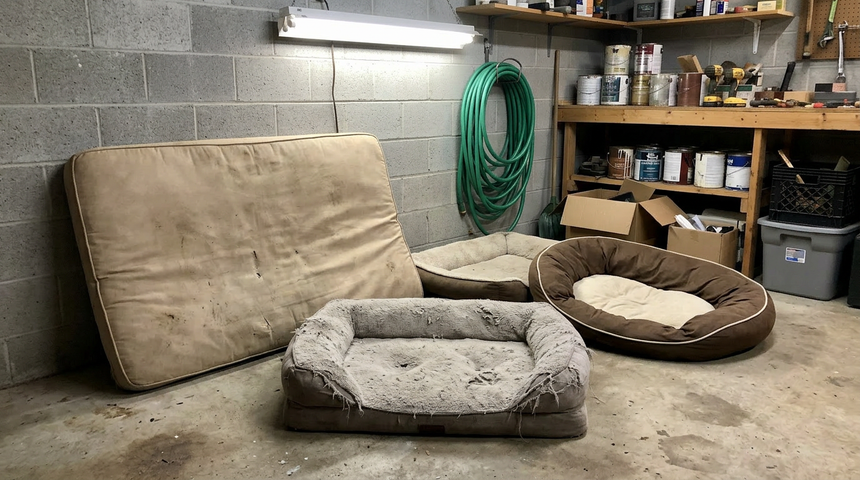
Eight months. $387. Three beds in the garage — and a dog who had stopped trusting beds entirely. That turned out to be the most expensive part, and the part no refund covers.
The thing nobody tells you
The reason I finally understood what was happening came from a woman who posts in an upholstery forum I'd been reading at 1am — a furniture-foam designer who builds custom orthopedic cushions for a living. I emailed her in frustration. She answered the same day.
Her first sentence was the most useful thing I've read about dog beds: Orthopedic is not a regulated word in the U.S. pet category. Anyone can put it on a bed.
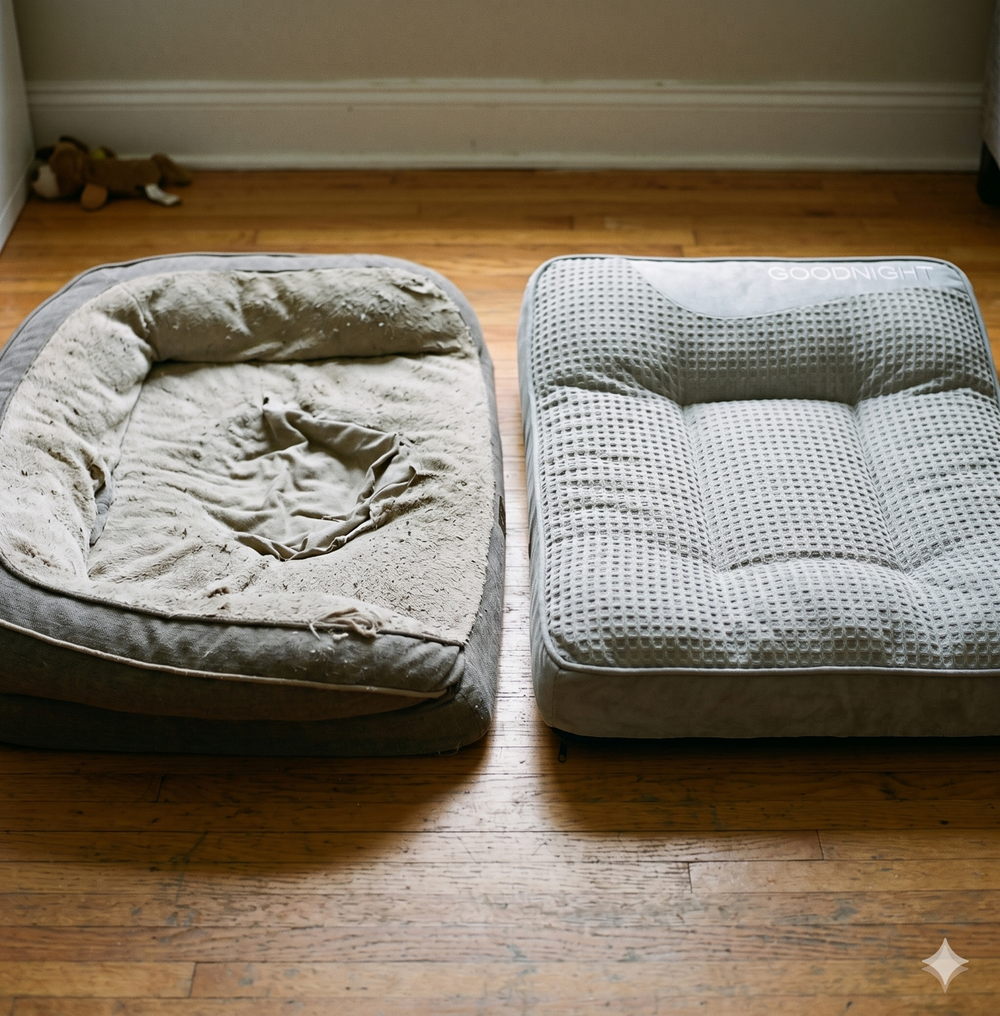
Most beds sold with that word use the cheapest possible filler — low-density polyfill or shredded scrap foam. It compresses under the weight of the dog within weeks. When it compresses, the dog isn't sleeping on the bed anymore. They're sleeping through it, with their joints pressed against the floor underneath. Hips. Elbows. Shoulders. All the pressure points that hurt the most on an aging dog.
That was Bear's problem, decoded. He'd lay down. His joints would sink through the foam. The pressure would build. Within minutes he'd push back up to escape it, circle looking for a position that didn't hurt — and there wasn't one. Not on that bed. The cycle wasn't aging. The cycle was him politely, wordlessly telling me the bed was hurting him. Every single night. For two years.
He was effectively sleeping on hardwood. His body knew it. I didn't.
"He was effectively sleeping on hardwood. His body knew it."
The four structural things to check before buying any senior dog bed.
See the bed Bear sleeps on nowWhat was actually missing
The designer answered me in two emails. Reading them back now, there are four things that were missing from every bed I'd bought Bear, and every one of them was something I'd already watched him struggle with without knowing what I was watching.
The first thing
The bed kept giving way under him. By week three of bed two, I could press my hand into the middle and feel the floor through the foam. The designer told me the reason is that almost every bed in the senior dog category is one foam layer. That's the whole bed. The memory foam on top is supposed to contour to a dog's body, and it does. Memory foam is designed to give. What's missing underneath it is a closed-cell high-density base that holds the shape. Without that base, the contouring just keeps going until Bear's hips were sitting on the hardwood through the foam. He wasn't sleeping on the bed. He was sleeping through it.
The second
He stopped getting onto bed three around month two. I thought he was rejecting the bed. He wasn't. He couldn't get over the wall. Most "premium" senior dog beds have a tall bolster around the whole perimeter, and for a dog with bad hips that's a wall. He had to lift over it every time he wanted to lay down. The designer told me a senior dog bed needs a low front edge, low enough that the dog steps on instead of climbs over. Bear hadn't given up on beds. He'd given up on the climb.
The third
The bed kept sliding when he tried to push off. I'd watch him try to stand and the whole bed would shoot back six inches. He'd land on the floor and look at me like I'd done something to him. The designer explained that almost every bed in the senior category uses a fabric base on the bottom, and fabric on hardwood is basically a sled. What Bear needed was a rubberized non-slip base that stays put when he leveraged off it. So he could get his back legs under him without falling.
The fourth
Bed two stopped being a bed after the first wash. The zipper cracked when I tried to take the cover off. After that I couldn't get the cover off cleanly. The smell built over six weeks, and Bear wouldn't go near it. The designer told me almost every bed uses a plastic-toothed zipper that fails on the first hot wash, and almost none of them have an inner waterproof liner. So when the cover finally fails, the foam itself absorbs everything underneath. What I needed was a metal industrial zipper and a sealed waterproof inner liner. The cover comes off, washes hot, goes back on. The foam stays dry the whole time.
Reading those two emails back, the thing that stayed with me wasn't relief. It was how none of it had been my fault. I'd watched Bear do all four of these things — sink, refuse the climb, slide, walk away from the washed bed — and I'd read every one of them as my dog getting old or getting fussy. They weren't him. They were four specific structural failures, on four specific beds, that I had no way of naming because nobody sells you the vocabulary. You didn't miss this because you were careless. You missed it because the word on the label was built to make you miss it.
The replies that hit me hardest weren't from people thanking me for the column. They were from owners who'd been through the same eight months, with a different dog. These are three.
Tank had been sleeping on the bathroom tile for almost a year. He'd walk past every bed I'd bought him to lay on the tile. The second night this one was in the house, he claimed it. He hasn't gone back to the tile since.
David L. in Phoenix, AZ. Dog: Tank, pit mix, 6 years old.
Otis is 152 pounds with bilateral hip dysplasia. For the last year I'd been helping him stand by lifting his back end with a towel under his belly. Three weeks on this bed and he started getting up on his own again. I cried the first time I watched him do it.
Sarah K. in Brooklyn, NY. Dog: Otis, mastiff, 7 years old.
Biscuit is 14 and she'd stopped sighing when she lay down. I hadn't realized I was missing the sound until she made it again on this bed, the second night. It's a small thing. I know how that sounds. But that sigh meant her body had stopped bracing.
Patricia H. in Tampa, FL. Dog: Biscuit, beagle, 14 years old.
The bed Laura switched to. The one that ended the cycle for Bear.
See sizes and 30-night trialA note before this next part. PawTherapy reached out to me after I'd already been using the bed for four months. I want to be specific about that timeline because it matters. I had nothing to say to them until I had something real to report. They paid me an editorial fee that doesn't change based on whether anyone buys anything. That fee is the reason this column exists on a sponsored platform instead of just my Facebook. Everything I'm about to tell you is what I'd tell a friend who asked.
The one I finally tried
The bed I'm using now is from a brand called PawTherapy. They sponsor this column, and I'd been using the bed for four months before they ever contacted me. I keep repeating that timeline because it matters: I had nothing to say to them until I had something real to report.
I picked it because it was the only bed I found that passed all four checks from the designer's emails. Closed-cell high-density base under the memory foam. Front edge low enough to step on, not climb over. Rubberized non-slip bottom across the whole base. Metal industrial zipper over a sealed waterproof liner — cover off in twelve seconds, hot wash, back on.
Bear's size is the Large, $139. Ordered Tuesday, arrived Friday.
And here is the part I almost got wrong. The bed comes with a slim guide called The First-Night Protocol — a day-by-day, seven-day routine for getting a dog who has given up on beds to actually claim a new one. I nearly filed it in the drawer where instructions go to die. I'm glad I didn't, because it opens with a sentence written for exactly the dog lying on my floor: "A new bed is a stranger. To your dog, it doesn't smell like them, it doesn't smell like you, and it has appeared in their world out of nowhere."
That sentence understood Bear better than I had been understanding him. After three failed beds, the problem wasn't going to be the foam. It was going to be his memory of every bed before it. The Protocol told me to air the bed out before he ever met it (new foam smells like a factory to a nose like his), exactly where to put it, and how to make it smell like us before asking anything of him — five minutes a day, no coaxing, no lifting him onto it. I followed it. Night one he ignored it. Night two he sniffed it and walked past — and the Protocol had told me he might, which is the only reason I didn't panic-return bed number four.
Night four, he claimed it.
Stopped pacing. Started sleeping through. I started sleeping through. He's still arthritic. He's still eleven. But he's not in pressure pain on top of the arthritis anymore — and that, it turns out, was most of what was wrong.
"The answer wasn't a more expensive version of the same wrong thing. It was a structurally different thing."
What I'd tell someone in week six of "the cycle"
If your dog is pacing at 2am, or circling before lying down, or pushing themselves up every few minutes and you've been calling it age — I'm not going to tell you the bed is the problem. I'm telling you it was the problem for Bear, and the change was fast enough that I couldn't explain it any other way.
Change the surface first. Before the supplements. Before another vet visit where you hear "arthritis is normal at his age." Before anything else that costs more and takes longer. Because if the surface is the problem, everything else you're trying is managing symptoms while the cause gets worse every night.
The four things matter. Not the brand — the specs. High-density base. Low front entry. Non-slip bottom. Industrial zipper. That's the whole checklist. Most beds fail at the first one.
I spent $387 on three beds in eight months looking for something that cost less than it should. The Large that worked cost $139. The $89 bed and the $134 bed and the $164 bed cost me $387 and a dog who had stopped trusting beds entirely. The math is not complicated.
I don't know what's waking your dog up at 2am. But I know what was waking mine, and I know it had a $139 fix and a four-night timeline that I missed for eight months — because I kept reading the word orthopedic instead of looking at the actual foam.
One more thing — why the trial works the way it does. When I asked PawTherapy why they run the offer like this — 30 nights, free courier pickup, no return shipping — the answer was the most commercially honest thing I heard in this whole saga. Nobody buying this bed is buying their first bed. Almost everyone who lands on their page has two or three failed beds in the garage and has stopped believing the word on the label. You can't talk a person like that into trusting you. You can only remove every ounce of the risk and let the dog give the verdict. They'd rather eat the cost of a courier than ask a three-times-burned owner to take anyone's word for it — including mine.
That's also why they include the First-Night Protocol instead of just washing instructions. They know the bed isn't fighting your skepticism. It's fighting your dog's.
You noticed the circling. You counted the times he got up. You're the one reading a 2,000-word article about foam density because of a dog. The people who do that are not the people who failed their dogs. They're the ones their dogs were lucky to get. The only thing missing was information. Now you have it.
There are two versions of you reading this column six weeks from now.
One ordered the bed tonight, followed the Protocol, watched the dog claim it inside a week, and stopped checking the time at 2am. The other waited, and the cycle kept going, and is reading another column like this one at 1am instead of sleeping.
I waited eight months. I do not recommend it.
THE BED — $79 (S) · $109 (M) · $139 (L, Bear's size — fits most Labs and Goldens) · $169 (XL).
FREE WITH EVERY BED — The First-Night Protocol: the exact 7-day routine that gets even stubborn or anxious dogs sleeping on their new bed. Why good beds get ignored, where to place it, what to do on the nights he walks past it, plus the 2am calm-down routine for restless sleepers. They'd sell it for $29. It's yours.
THE TRIAL — 30 nights. If your dog doesn't claim it, a courier picks it up at your door, free. You don't box anything. You don't pay anything. The dog is the judge.
Free shipping in the US. Ships within 24 hours.
From $79, First-Night Protocol included. Most Lab and Golden owners need the Large at $139.
Ships in 24 hours
30-night free trial
Free pickup if returned
P.S. One thing from the First-Night Protocol you can use with any new bed, whatever you decide about this one: when it arrives, unzip the cover and let the foam air out for a day or two before your dog ever meets it. Fresh foam carries a faint factory smell you can barely detect — and to a nose ten thousand times more sensitive than yours, it's a reason to keep away. Half of "my dog rejected the new bed" stories are actually that smell. Nobody told me that across three beds and $387. It's on page two of the guide, and the guide comes free with every bed — because PawTherapy figured out the thing I learned the hard way: the bed has to win over the dog, not the owner.
Reader comments 89
I had the exact same eight months with my 12-year-old shepherd mix. Three beds, all bottomed out, until I read this. Ordered the Large after seeing this column. He's been on it for three weeks and the pacing stopped after night six. Thank you for writing this — I cried when I read the part about him sleeping through the night because that was the part I had stopped believing was possible.
The four structural things list is what I needed five years ago. I have probably spent over $600 on dog beds for two senior labs. Wish someone had written this in 2021.
My vet recommended I look into "joint support beds" but never said what to look for. This is the most actionable thing I've read about senior dog care this year. Sending it to my mom — her old goldie has the exact same circling problem.